
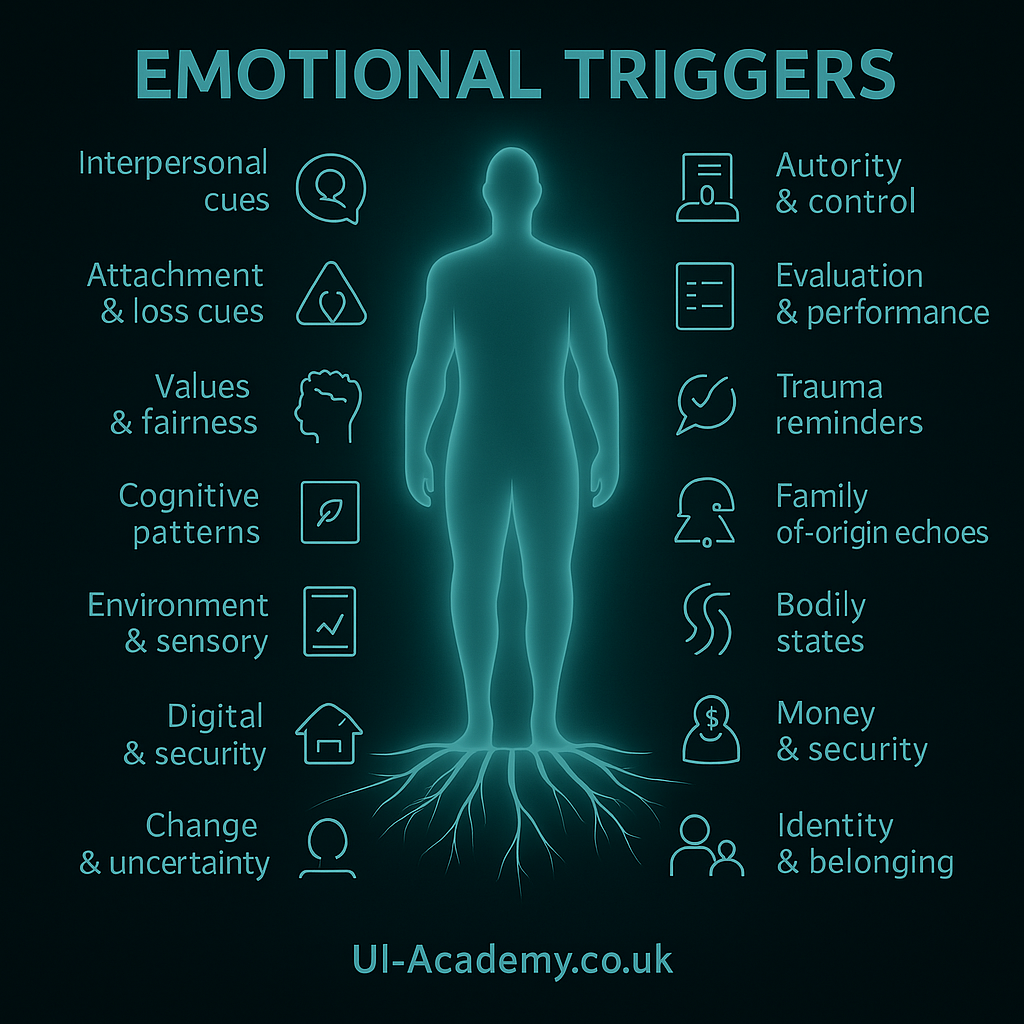
Emotional triggers are specific cues, which can be external, like certain environments, words, or actions, or internal, such as thoughts, memories, or bodily sensations. These triggers reliably provoke intense emotional reactions that often feel disproportionate to the current situation. They tend to evoke strong feelings quickly because they are deeply connected to our past experiences, core beliefs, or unmet needs. These triggers can activate old memories or patterns of thinking that influence how we respond emotionally in the present, often without our full awareness.
- Interpersonal cues
Tone of voice, criticism, being interrupted, feeling ignored, microaggressions, and someone “stonewalling.” - Attachment & loss cues
Goodbyes, cancellations, silence after a message, perceived rejection, “we need to talk.” - Authority & control
Being told what to do, surveillance, unfair rules, and someone moving the goalposts. - Evaluation & performance
Deadlines, exams, public speaking, being compared, “Can I give you some feedback?” - Values & fairness
Disrespect, hypocrisy, broken promises, and witnessing injustice (personal or societal). - Trauma reminders
Sounds, smells, places, anniversaries, phrases, and power dynamics that echo the original event. - Family-of-origin echoes: A partner’s sigh that resembles Dad’s, a colleague’s sarcasm like an older sibling’s, and holidays.
- Bodily states (the sneaky ones)
Hunger, fatigue, pain, hormones, illness, caffeine spikes, alcohol/drug effects or withdrawal. - Cognitive patterns (schemas/beliefs)
Perfectionism, “I’m not enough,” fear of abandonment, mistrust, failure schemas, and catastrophising. - Environment & sensory
Crowds, clutter, noise, flashing lights, strong smells, temperature, and messy spaces. - Money & security
Unexpected bills, debt emails, job instability, and price talk at the till. - Digital/media
Social comparison scrolls, doom news, an email from that person, “Seen 10:03” with no reply. - Change & uncertainty
Moves, new roles, endings/beginnings, ambiguous plans, waiting for results. - Identity & belonging
Being misunderstood, misgendered/misnamed, stereotyped, and excluded from the group chat.
Positive triggers (yep, those too)
Music, smells, places, or faces that flood you with warmth, nostalgia, or joy.
Change & uncertainty:
Awareness improves when you can measure it, and that’s where the Emotional BaseLine Tracker proves beneficial. A quick check-in before and after an event transforms an unclear mood into a clear signal: “I was at 40 after the meeting; after a boundary reset and a short walk, I was at 78.” Track a few to identify patterns, what reliably spikes your mood, what calms you, and which interventions genuinely affect that emotional score, not just your hopes.
Bringing it all together: triggers will still occur, but Emotional Baseline and emotional awareness determine who responds, whether it’s you or your emotional state, and for how long. Map the cue, body, emotion, story, and need, then take a wise next step. Observe your numbers shift positively over time. That’s how you replace reactivity with response, reduce the whiplash, and develop steadier hands on the wheel.